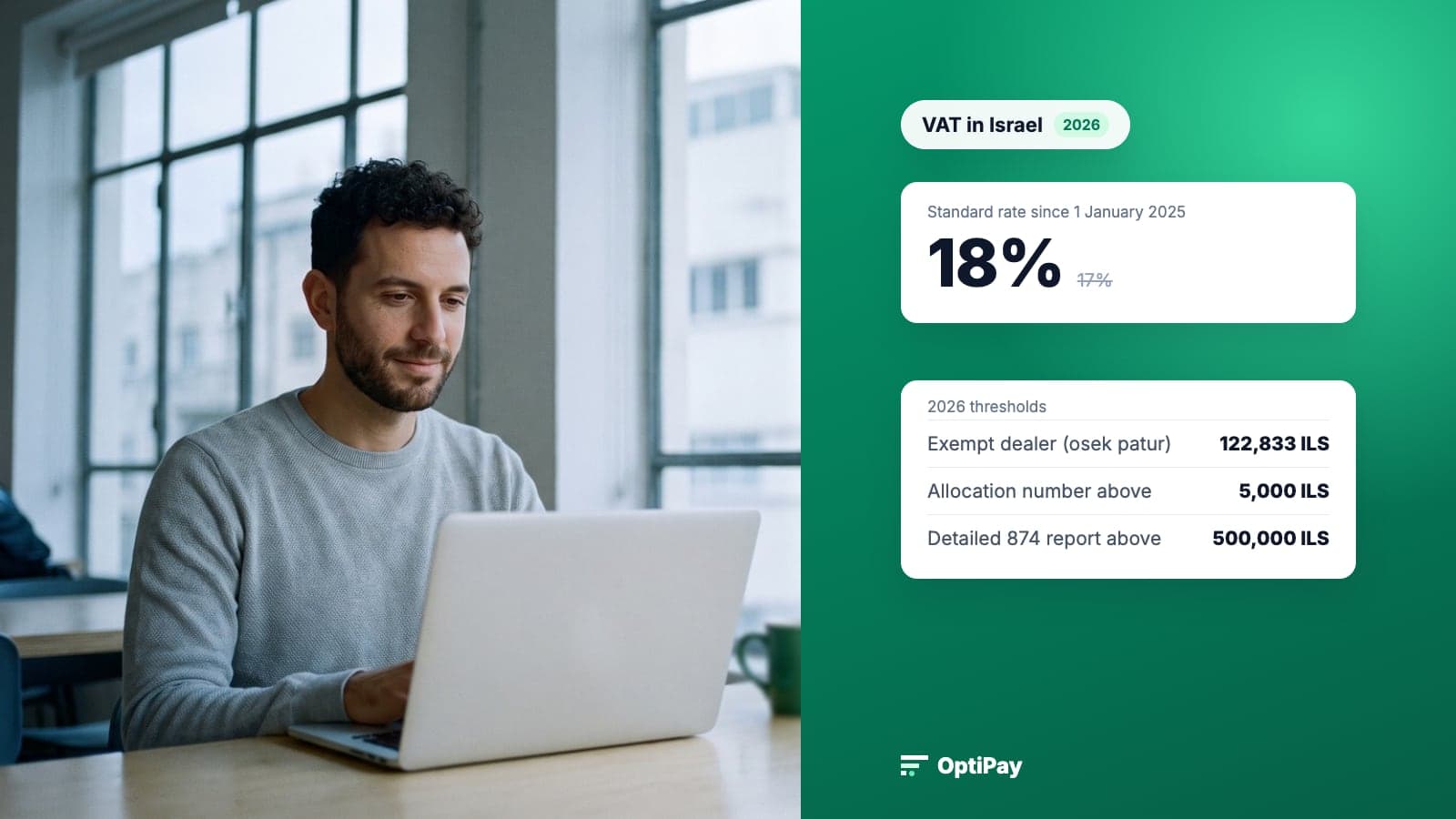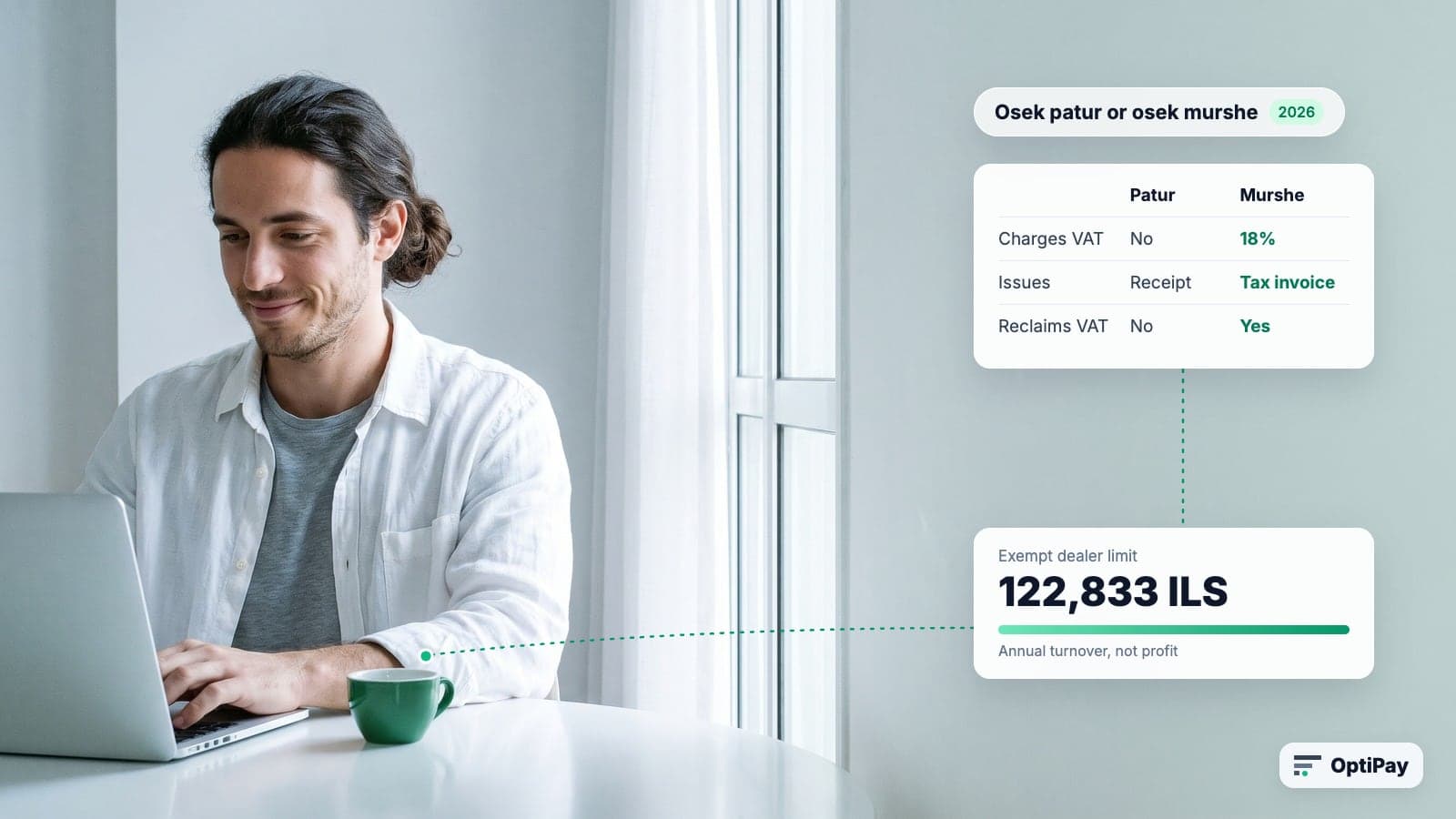
An osek patur (exempt dealer) does not charge VAT and cannot reclaim it. An osek murshe (licensed dealer) charges 18% VAT, issues tax invoices and reclaims the VAT paid to suppliers. In 2026 you can be an osek patur only if your annual turnover stays at or below 122,833 ILS and your occupation is not one that must register as murshe from the first shekel.
Most English guides stop at "register with the VAT office". This one goes further: how the limit is measured, who never qualifies, what to do the day you cross it, and the part most freelancers miss, which supplier documents actually let you reclaim VAT once you are murshe.
The 2026 osek patur limit: 122,833 ILS
| Year | Exempt dealer turnover limit |
|---|---|
| 2025 | 120,000 ILS |
| 2026 | 122,833 ILS |
The figure comes from the Tax Authority's table of VAT amounts and sits in the definition of "osek patur" in section 1 of the VAT Law. Under section 126 it is updated every 1 January in line with the consumer price index. On average that is about 10,236 ILS of sales a month.
Turnover, not profit
The limit is measured on turnover: the total price of your sales in the year, before any expenses. A business that sold 150,000 ILS and kept 50,000 ILS after costs has passed the limit.
Two things do not count. Selling the business's own equipment is excluded from the definition. A salary does not count either: if you are employed and freelance on the side, only the freelance income is measured, as Kol Zchut explains.
Osek patur vs osek murshe at a glance
| Osek patur | Osek murshe | |
|---|---|---|
| Charges VAT to customers | No | Yes, 18% |
| Document issued to customers | Receipt or transaction invoice | Tax invoice |
| Reclaims VAT on expenses | No | Yes, from valid tax invoices |
| VAT reporting | One annual declaration | Every two months up to 1,775,000 ILS turnover, monthly above |
| Who it fits | Low turnover, customers who are mostly private | Higher turnover, or business customers who reclaim VAT |
Who must be osek murshe from day one
Under regulation 13 of the VAT (Registration) Regulations, some occupations register as licensed dealers at any turnover. Among them:
- Liberal professions: lawyers, accountants, tax advisers, bookkeepers, engineers, architects, technicians, economists, management consultants, translators, appraisers and more.
- Doctors, psychologists, physiotherapists, veterinarians and dentists.
- Driving schools, and kindergartens and schools that are not non-profits.
- Dealers and brokers in real estate or vehicles.
- Companies and cooperative societies.
If your work is on this list, you open an osek murshe from the first shekel, and everything below about reclaiming VAT applies to you from the start.
You crossed the limit: what to do and when
The definition of turnover in the VAT Law answers the "when". From the day it becomes clear that this year's turnover will pass the limit, the higher figure counts as your turnover for the rest of the year. In other words, the change does not wait for the end of the year.
- Change your status. Ask the VAT office to reclassify you as an osek murshe. Kol Zchut recommends doing it as soon as you expect to cross the limit, before the payment that takes you over it.
- Start issuing tax invoices. From now on every sale carries 18% VAT.
- File periodic reports. Every two months while turnover stays at or below 1,775,000 ILS. Above 500,000 ILS, a self-employed business also files the detailed VAT report (874), covered in our guide to VAT in Israel.
What changes on the expense side
As an osek patur, the VAT you pay suppliers is part of the expense. A printer that costs 1,000 ILS plus 180 ILS VAT is a 1,180 ILS expense for income tax. As an osek murshe the same printer is a 1,000 ILS expense, and the 180 ILS is offset against the VAT you collected from customers. In a month when the VAT you paid is larger than the VAT you collected, the difference comes back to you as a refund.
Not every document allows that. Under section 38 of the VAT Law:
| Condition | What it means in practice |
|---|---|
| A tax invoice issued to you lawfully | A tax invoice or a tax invoice-receipt. A plain receipt or a transaction invoice is not enough |
| From a supplier who is osek murshe | An osek patur may not issue a tax invoice |
| Within six months | The VAT is reclaimed within six months of the invoice date |
| An allocation number above 5,000 ILS | Since June 2026, a tax invoice above 5,000 ILS before VAT needs an allocation number |
There is no retroactive reclaim. According to Kol Zchut, you cannot claim back VAT on expenses from earlier in the year, only on expenses from the date you became murshe. A tax invoice that arrives the day after you switch is worth 18% more to you than the same invoice the day before, so the earlier you switch, the less VAT you lose.
Can you go back to osek patur?
Yes. Under section 59 of the VAT Law, an osek murshe whose turnover stays below the limit for two consecutive years is registered as an osek patur, at the director's initiative or at the business's request. This does not apply to the occupations that must be murshe at any turnover.
How OptiPay helps once you are osek murshe
Once the VAT on every supplier invoice is money, the question is how many invoices go missing on the way. OptiPay collects supplier invoices from Gmail, Outlook and WhatsApp and reads each one with AI: the supplier, the amount, the VAT and the document type. You see straight away which supplier sent a receipt instead of a tax invoice. At the end of each reporting period your accountant gets every input invoice in order, as described in what to send your accountant.
Frequently asked questions
What is the osek patur limit in 2026?
Annual turnover of 122,833 ILS, according to the Israel Tax Authority. In 2025 it was 120,000 ILS. The figure is set in the definition of an exempt dealer in section 1 of the VAT Law and is updated every 1 January in line with the consumer price index.
What is the difference between osek patur and osek murshe?
An osek patur (exempt dealer) does not charge VAT, cannot issue a tax invoice and cannot reclaim VAT on expenses. An osek murshe (licensed dealer) charges 18% VAT on sales, issues tax invoices, files periodic VAT reports and reclaims the VAT paid to suppliers. Which one you are depends on your turnover and your occupation.
Is the limit based on income or on profit?
On income. Turnover is the total price of your sales in the year, before expenses. A business that sold 150,000 ILS and kept 50,000 ILS after expenses has passed the limit. Sales of business equipment do not count, and neither does a salary from an employer if you are also employed.
Who cannot be an osek patur?
Under regulation 13 of the VAT (Registration) Regulations, some occupations register as osek murshe at any turnover, among them lawyers, accountants, tax advisers, bookkeepers, engineers, architects, economists, management consultants, translators, doctors, psychologists, physiotherapists and dentists, as well as companies.
Can I reclaim VAT on expenses from the time I was an osek patur?
No. An exempt dealer does not reclaim VAT, and switching to licensed dealer does not open the past. You reclaim the VAT on expenses from the date you became an osek murshe. The VAT on earlier expenses stays part of the expense for income tax.
Summary
In 2026 the line is 122,833 ILS of turnover, measured on sales and not on profit, and some occupations are osek murshe from the first shekel whatever they earn. Crossing the line is not just paperwork: from that day you charge 18%, issue tax invoices and can reclaim VAT, but only from proper tax invoices collected within six months.