VAT in Israel is 18% since 1 January 2025. Small businesses register either as an exempt dealer (osek patur), who does not charge VAT, or as a licensed dealer (osek murshe), who charges 18%, reports every one or two months and reclaims the VAT on business expenses. In 2026 the rules changed in three places: the exempt threshold, the detailed VAT report and the allocation numbers that large invoices now need.
Most English pages on Israeli VAT are written for tourists claiming a refund at the airport, or for foreign companies selling into Israel. This guide is for the business on the ground: what to register as, what to report and which invoices actually let you get VAT back.
The Israeli VAT rate in 2026
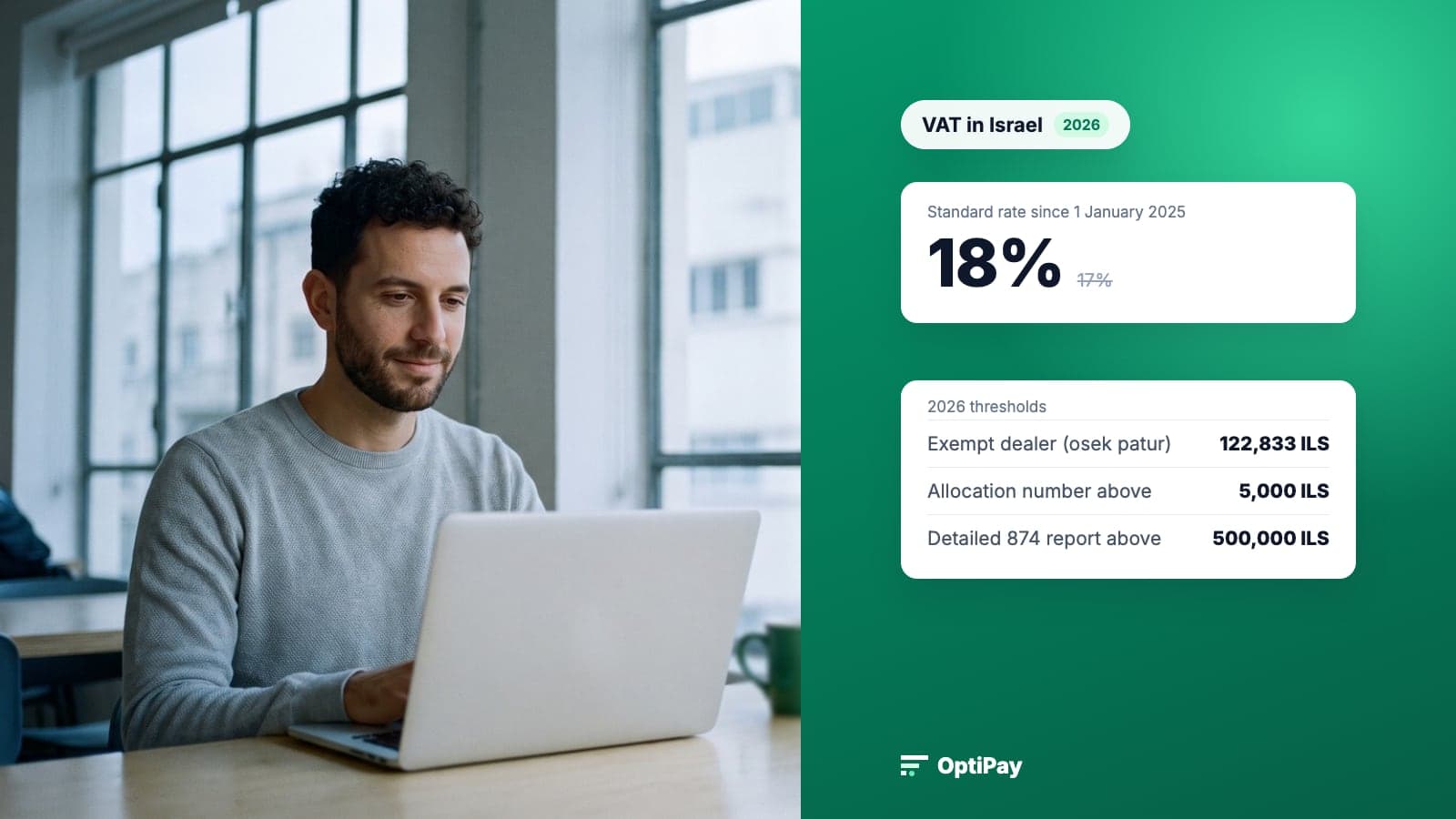
The standard rate is 18%. The Tax Authority's history of VAT rates shows it rose from 17% on 1 January 2025, after almost ten years at 17%. It applies to sales of goods and services in Israel and to imports of goods.
| 2025 | 2026 | |
|---|---|---|
| Standard VAT rate | 18% | 18% |
| Exempt dealer (osek patur) threshold | 120,000 ILS | 122,833 ILS |
| Allocation number needed above (before VAT) | 20,000 ILS | 10,000 ILS from January, 5,000 ILS from 1 June |
| Detailed VAT report for the self-employed | Not yet | Turnover above 500,000 ILS |
Osek patur or osek murshe
Every business that sells in Israel registers with VAT in one of two ways:
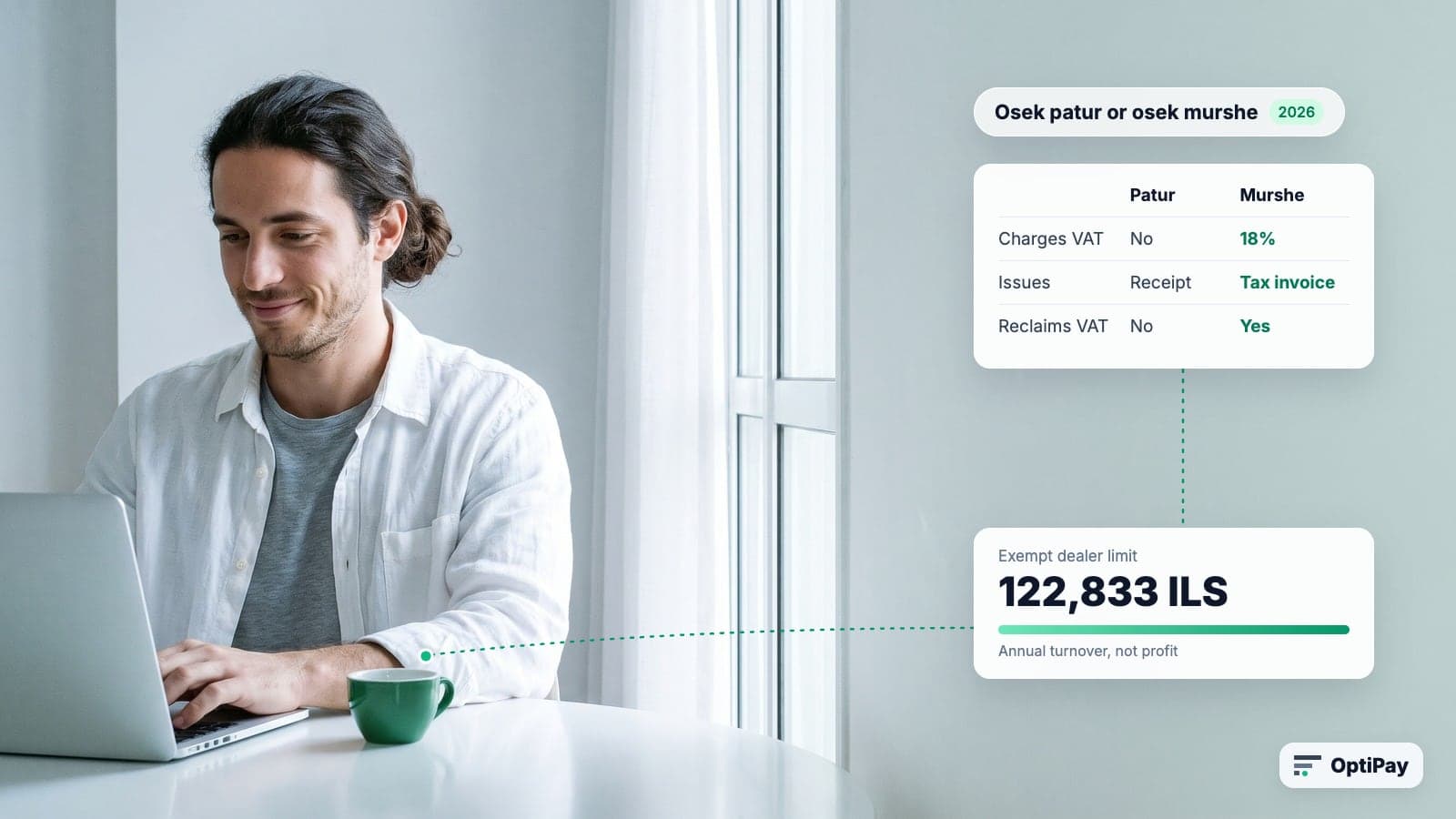
- Exempt dealer (osek patur). Annual turnover up to 122,833 ILS in 2026, per the Tax Authority's table of VAT amounts. It does not add VAT to its prices, may not issue a tax invoice and cannot reclaim VAT on what it buys. It does not file periodic VAT reports.
- Licensed dealer (osek murshe). Charges 18% VAT on its sales, issues tax invoices, files periodic reports and offsets the VAT it paid suppliers against the VAT it collected.
Turnover means total sales before expenses, not profit. A business that sold 150,000 ILS and kept 50,000 ILS has passed the threshold. For the full comparison, including what to do the day you cross the limit, see our guide to osek patur or osek murshe. Some occupations cannot be exempt dealers whatever their turnover. Under regulation 13 of the VAT (Registration) Regulations they include lawyers, accountants, tax advisers, bookkeepers, engineers, architects, economists, management consultants, translators, doctors, psychologists and dentists. If you are unsure which applies to you, your accountant or the regional VAT office can confirm it.
How often you report, and what it costs to be late
A licensed dealer files a periodic VAT report. According to the same Tax Authority table:
- Every two months when annual turnover does not exceed 1,775,000 ILS.
- Every month above that.
- Late reports carry a fine of 252 ILS for every two weeks or part of them.
If the VAT you paid suppliers is larger than the VAT you collected, the report shows a refund. Under section 39 of the VAT law it is due within 30 days of the report, 90 days if the Tax Authority orders an audit of the books, and 180 days if an investigation is opened.
Which invoices let you reclaim VAT
This is where most small businesses lose money. Input VAT can be reclaimed only from:
- A tax invoice (cheshbonit mas), not a receipt, a transaction invoice or a proforma.
- Issued to your business by a licensed dealer. An exempt dealer cannot issue one.
- Within six months of the invoice date.
- With an allocation number when the invoice is above 5,000 ILS before VAT (see the next section).
A supplier who hands you a receipt or a transaction invoice has not given you anything you can reclaim, however much VAT it shows. On a purchase above 362 ILS for your business, section 47A of the VAT law requires you to ask a licensed dealer for a tax invoice or to pay by bank transfer, card or a cheque payable to the seller only. From 29,112 ILS you must ask for a tax invoice and may not pay in cash.
Allocation numbers (Israel Invoices)
Since 2024 Israel has been rolling out a real-time e-invoicing model known as Israel Invoices (cheshbonit Israel). The supplier requests a nine-digit allocation number from the Tax Authority for a specific tax invoice, and without it the buyer cannot reclaim that invoice's VAT. The threshold has dropped every year:
| Period | Allocation number needed when the invoice exceeds (before VAT) |
|---|---|
| 2024 | 25,000 ILS |
| 2025 | 20,000 ILS |
| 1 January to 31 May 2026 | 10,000 ILS |
| From 1 June 2026 | 5,000 ILS |
If a large invoice arrives without a number, ask the supplier to add it: according to the Tax Authority's Israel Invoices FAQ, a number can be requested retroactively for up to a year after the invoice date. Credit notes do not need an allocation number at all, of any amount.
The detailed VAT report (874)
The detailed report, named after the PCN874 file it is sent in, lists every sales invoice and every supplier invoice on its own line instead of in totals. Under section 69A of the VAT law, as amended by the 2025 Economic Arrangements Law, it applies to businesses with turnover above 500,000 ILS, and to self-employed individuals from the January 2026 report, per the Tax Authority's August 2025 announcement.
Two reliefs in that announcement apply only to individuals, not companies:
- Small invoices can be grouped. Supplier invoices up to 5,000 ILS before VAT each may be reported as a single total line instead of one line each.
- A deferral to 2027. An individual can ask the regional VAT office to start in January 2027 if, in the 2025 reports, at least 90% of input invoices by amount, or by count, were invoices of up to 5,000 ILS.
Every supplier invoice above 5,000 ILS appears on its own line with its allocation number, and the Tax Authority matches it against what the supplier reported. That is where a missing number or a document that is not a tax invoice gets caught.
Credit notes
When a supplier credits you for a return or a discount, the credit note reduces the VAT you reclaimed. Under regulation 24(b) of the VAT regulations, you correct your input VAT in the report for the period in which you received the credit note, not the period of the original invoice. The supplier may reduce its own VAT only once you confirm receipt, which is why suppliers sometimes ask you to sign or acknowledge a credit note.
How OptiPay keeps your VAT documents in order
OptiPay collects supplier invoices from Gmail, Outlook and WhatsApp and reads each one with AI: the document type, the amount, the VAT and the supplier. A receipt is marked as a receipt and a credit note as a credit, so neither goes into your VAT claim as if it were a tax invoice. At the end of each reporting period your accountant gets the documents and an export that is ready to work from, as described in what to send your accountant.
Frequently asked questions
What is the VAT rate in Israel in 2026?
The standard rate is 18%. It rose from 17% on 1 January 2025, according to the Israel Tax Authority, and has not changed since. It applies to sales of goods and services in Israel and to imports.
What changed in Israeli VAT in 2026?
Three things for small businesses. The exempt-dealer (osek patur) threshold rose to 122,833 ILS of annual turnover. Self-employed businesses with turnover above 500,000 ILS began filing the detailed VAT report (874) from the January 2026 report. And the invoice amount that needs an allocation number before you can reclaim its VAT dropped to 10,000 ILS in January and to 5,000 ILS on 1 June 2026.
Do I have to charge VAT as a freelancer in Israel?
Only if you are registered as a licensed dealer (osek murshe). An exempt dealer (osek patur), whose annual turnover does not exceed 122,833 ILS in 2026, does not charge VAT, cannot issue a tax invoice and cannot reclaim VAT on expenses. Once turnover passes the threshold, you move to licensed dealer status.
How often do Israeli businesses report VAT?
Every two months if annual turnover does not exceed 1,775,000 ILS, and monthly above that. A late report carries a fine of 252 ILS for every two weeks or part of them.
Can I reclaim VAT with a receipt?
No. Input VAT can be reclaimed only from a tax invoice issued to your business by a licensed dealer, and within six months of the invoice date. A receipt, a transaction invoice or a proforma does not allow a reclaim. Above 5,000 ILS before VAT, the tax invoice also needs an allocation number.
Summary
Israeli VAT is 18%. If you are a licensed dealer, the money you can save sits in the input side: reclaim only from tax invoices, within six months, and make sure every invoice above 5,000 ILS carries an allocation number before it goes into the report. The rest, from the report frequency to the detailed report, follows from your turnover.